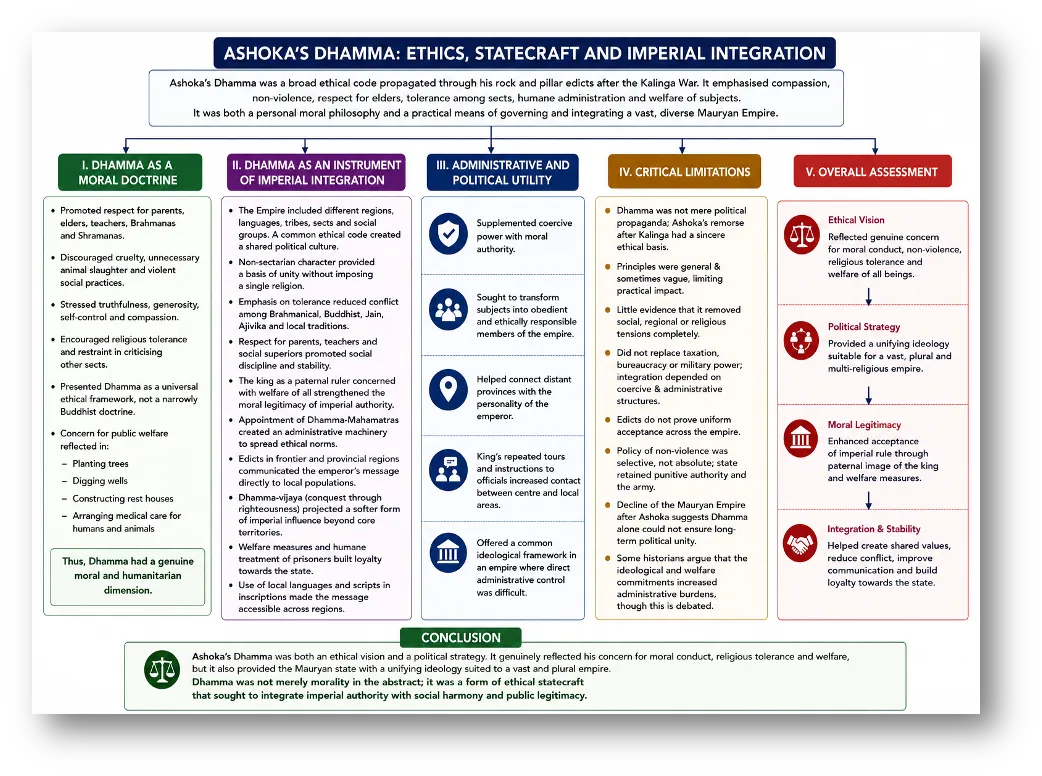
Ashoka’s Dhamma was not merely a moral doctrine, but an instrument of imperial integration in a culturally diverse empire
Last Updated
18th July, 2026
Date Published
17th July, 2026
Share This Post With Someone

Ashoka’s Dhamma was a broad ethical code propagated through his rock and pillar edicts after the Kalinga War. It emphasised compassion, non-violence, respect for elders, tolerance among sects, humane administration and welfare of subjects. However, Dhamma was not only a personal moral philosophy; it also served as a practical means of governing and integrating a vast, socially and culturally diverse Mauryan Empire.
Dhamma as a moral doctrine
- It promoted respect for parents, elders, teachers and Brahmanas and Shramanas.
- It discouraged cruelty, unnecessary animal slaughter and violent social practices.
- It stressed truthfulness, generosity, self-control and compassion.
- It encouraged religious tolerance and restraint in criticising other sects.
- Ashoka presented Dhamma as a universal ethical framework rather than as a narrowly Buddhist doctrine.
His concern for public welfare is reflected in measures such as:
- Planting trees,
- Digging wells,
- Constructing rest houses,
- Arranging medical care for humans and animals.
Thus, Dhamma had a genuine moral and humanitarian dimension.
Dhamma as an instrument of imperial integration
- The Mauryan Empire included different regions, languages, tribes, sects and social groups. A common ethical code helped create a shared political culture.
- Dhamma avoided imposing a single religion and therefore provided a non-sectarian basis of unity.
- Its emphasis on tolerance reduced the possibility of conflict among Brahmanical, Buddhist, Jain, Ajivika and local traditions.
- Respect for parents, teachers and social superiors supported social discipline and stability.
- By presenting the king as a paternal ruler concerned with the welfare of all, Ashoka strengthened the moral legitimacy of imperial authority.
- The appointment of Dhamma-Mahamatras created an administrative machinery for spreading ethical norms across the empire.
- Edicts placed in frontier and provincial regions communicated the emperor’s message directly to local populations.
- The policy of Dhamma-vijaya, or conquest through righteousness, projected a softer form of imperial influence beyond the core territories.
- Welfare measures and humane treatment of prisoners helped build loyalty toward the state.
- The use of local languages and scripts in inscriptions made the imperial message accessible in different regions.
Administrative and political utility
- Dhamma helped supplement coercive power with moral authority.
- It sought to transform subjects into obedient and ethically responsible members of the empire.
- It helped connect distant provinces with the personality of the emperor.
- The king’s repeated tours and instructions to officials increased contact between the centre and local areas.
- It offered a common ideological framework in an empire where direct administrative control was difficult.
Critical limitations
- Dhamma should not be reduced merely to political propaganda; Ashoka’s remorse after Kalinga appears to have had a sincere ethical basis.
- Its principles were general and sometimes vague, which may have limited their practical impact.
- There is little evidence that Dhamma completely removed social, regional or religious tensions.
- The policy did not replace taxation, bureaucracy or military power; imperial integration still depended upon coercive and administrative structures.
- The existence of edicts does not prove uniform acceptance across the empire.
- Ashoka’s policy of non-violence was selective rather than absolute; the state retained punitive authority and the army.
- The decline of the Mauryan Empire after Ashoka suggests that Dhamma alone could not ensure long-term political unity.
- Some historians argue that the ideological and welfare commitments of Dhamma may have increased administrative burdens, though this remains debated.
Ashoka’s Dhamma was both an ethical vision and a political strategy. It genuinely reflected his concern for moral conduct, religious tolerance and welfare, but it also provided the Mauryan state with a unifying ideology suited to a vast and plural empire. Therefore, Dhamma was not merely morality in the abstract; it was a form of ethical statecraft that sought to integrate imperial authority with social harmony and public legitimacy.