
MAINS A DAY
General Studies I
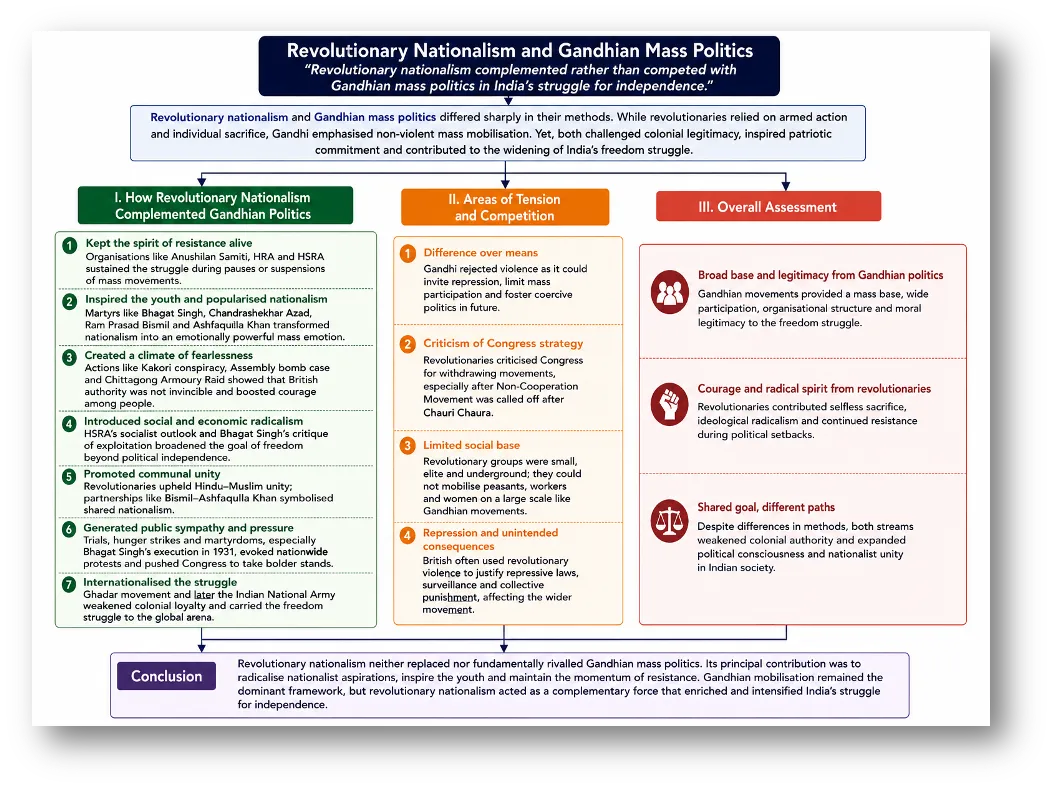
Revolutionary nationalism complemented rather than competed with Gandhian mass politics in India’s struggle for independence. Examine.
Last Updated
18th July, 2026
Date Published
17th July, 2026
Share This Post With Someone

Revolutionary nationalism and Gandhian mass politics differed sharply in their methods. While revolutionaries relied on armed action and individual sacrifice, Gandhi emphasised non-violent mass mobilisation. Yet, both challenged colonial legitimacy, inspired patriotic commitment and contributed to the widening of India’s freedom struggle.
How revolutionary nationalism complemented Gandhian politics
- Revolutionary organisations such as the Anushilan Samiti, Hindustan Republican Association and HSRA kept the spirit of resistance alive during periods when mass movements had been suspended or had lost momentum.
- The sacrifices of Bhagat Singh, Chandrashekhar Azad, Ram Prasad Bismil and Ashfaqulla Khan inspired the youth and transformed nationalism from an elite political demand into an emotionally powerful popular cause.
- Actions such as the Kakori conspiracy, the Assembly bomb case and the Chittagong Armoury Raid demonstrated that colonial authority was not invincible and created a climate of fearlessness that indirectly strengthened mass resistance.
- Revolutionary nationalism introduced a strong social and economic dimension to the freedom struggle. The HSRA’s commitment to socialism and Bhagat Singh’s critique of exploitation pushed nationalism beyond mere political independence.
- The revolutionaries’ emphasis on Hindu-Muslim unity complemented the inclusive character of Gandhian mobilisation. The partnership of Bismil and Ashfaqulla Khan became a symbol of shared nationalism.
- Revolutionary trials, executions and hunger strikes generated widespread public sympathy. Bhagat Singh’s execution in 1931 produced nationwide protests and increased pressure on the Congress leadership to adopt a stronger position against British rule.
- Revolutionary activities abroad, including the Ghadar movement and later the Indian National Army, internationalised the struggle and weakened the image of unquestioned loyalty within the colonial armed forces.
Areas of tension and competition
- Gandhi rejected political violence because he believed that violent methods could invite repression, restrict popular participation and reproduce coercive politics after independence.
- Revolutionary groups sometimes criticised the Congress for withdrawing movements, particularly after the suspension of the Non-Cooperation Movement following Chauri Chaura.
- Revolutionary action remained largely confined to small, disciplined groups and could not mobilise peasants, workers and women on the scale achieved by Gandhian movements.
- British authorities frequently used revolutionary violence to justify repressive laws, surveillance and collective punishment, which could adversely affect the wider nationalist movement.
Overall assessment
- Gandhian politics provided the freedom struggle with its broad social base, organisational continuity and moral legitimacy.
- Revolutionary nationalism supplied courage, sacrifice, ideological radicalism and sustained resistance during political setbacks.
- Although the two streams differed over means, both weakened colonial authority and expanded the political consciousness of Indian society.
- Revolutionary nationalism neither replaced nor fundamentally rivalled Gandhian mass politics. Its principal contribution was to radicalise nationalist aspirations, inspire the youth and maintain the momentum of resistance. Gandhian mobilisation remained the dominant framework, but revolutionary nationalism acted as a complementary force that enriched and intensified India’s struggle for independence.
MAINS A DAY
General Studies I


General Studies I
UPSC Mains PYQs