
MAINS A DAY
General Studies I
The French Revolution established the principles of modern democracy but also demonstrated the dangers of revolutionary extremism." Critically analyse.
Last Updated
18th July, 2026
Date Published
17th July, 2026
Share This Post With Someone

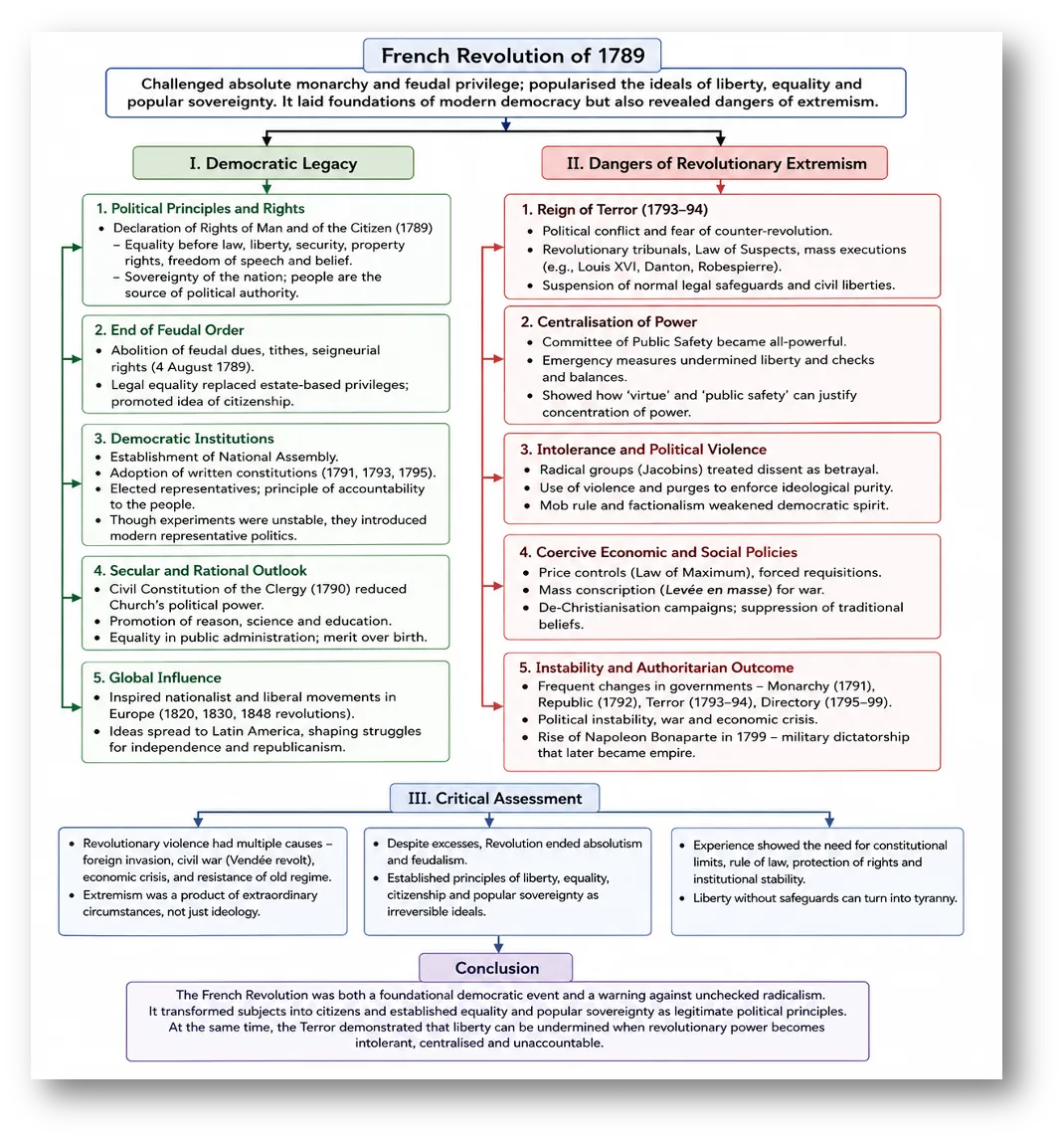
The French Revolution of 1789 challenged absolute monarchy and feudal privilege and popularised the ideals of liberty, equality and popular sovereignty. It laid important foundations of modern democratic politics, but the Reign of Terror and political instability also revealed how revolutionary idealism could turn into coercion and authoritarianism.
Democratic legacy
- The Declaration of the Rights of Man and of the Citizen proclaimed equality before law, individual liberty, freedom of expression and the principle that sovereignty rested with the nation rather than the monarch.
- The abolition of feudal dues and hereditary privileges weakened the old estate-based order and promoted the modern idea of legal citizenship.
- The Revolution introduced representative institutions, written constitutions and the principle of political accountability, even though these experiments remained unstable.
- The spread of secular and rational principles reduced the political dominance of the Church and encouraged equality in public administration.
- Revolutionary ideas later influenced nationalist and democratic movements across Europe and Latin America.
Dangers of revolutionary extremism
- Political conflict and fear of counter-revolution led to the Reign of Terror, during which revolutionary tribunals and mass executions replaced normal legal safeguards.
- The Committee of Public Safety centralised power in the name of defending the Revolution, showing how emergency politics could undermine liberty.
- Radical groups treated political disagreement as betrayal, allowing ideological purity to justify violence.
- Economic controls, forced mobilisation and de-Christianisation campaigns demonstrated the coercive side of revolutionary transformation.
- Continued instability eventually facilitated the rise of Napoleon Bonaparte, who preserved some revolutionary reforms but established authoritarian rule.
Critical assessment
- Revolutionary violence did not arise only from ideology; it was also shaped by foreign invasion, civil war, economic crisis and royal resistance.
- Despite its excesses, the Revolution permanently destroyed many structures of feudal privilege and made popular sovereignty central to modern politics.
- Its experience showed that democratic goals require constitutional limits, institutional stability and protection of civil liberties.
- The French Revolution was both a foundational democratic event and a warning against unchecked radicalism. It transformed subjects into citizens and established equality and popular sovereignty as legitimate political principles. At the same time, the Terror demonstrated that liberty can be undermined when revolutionary power becomes intolerant, centralised and unaccountable.
MAINS A DAY
General Studies I


General Studies I
UPSC Mains PYQs