
MAINS A DAY
General Studies I
The Green Revolution transformed India's food security while simultaneously creating new regional and socio-economic disparities. Discuss.
Last Updated
18th July, 2026
Date Published
17th July, 2026
Share This Post With Someone

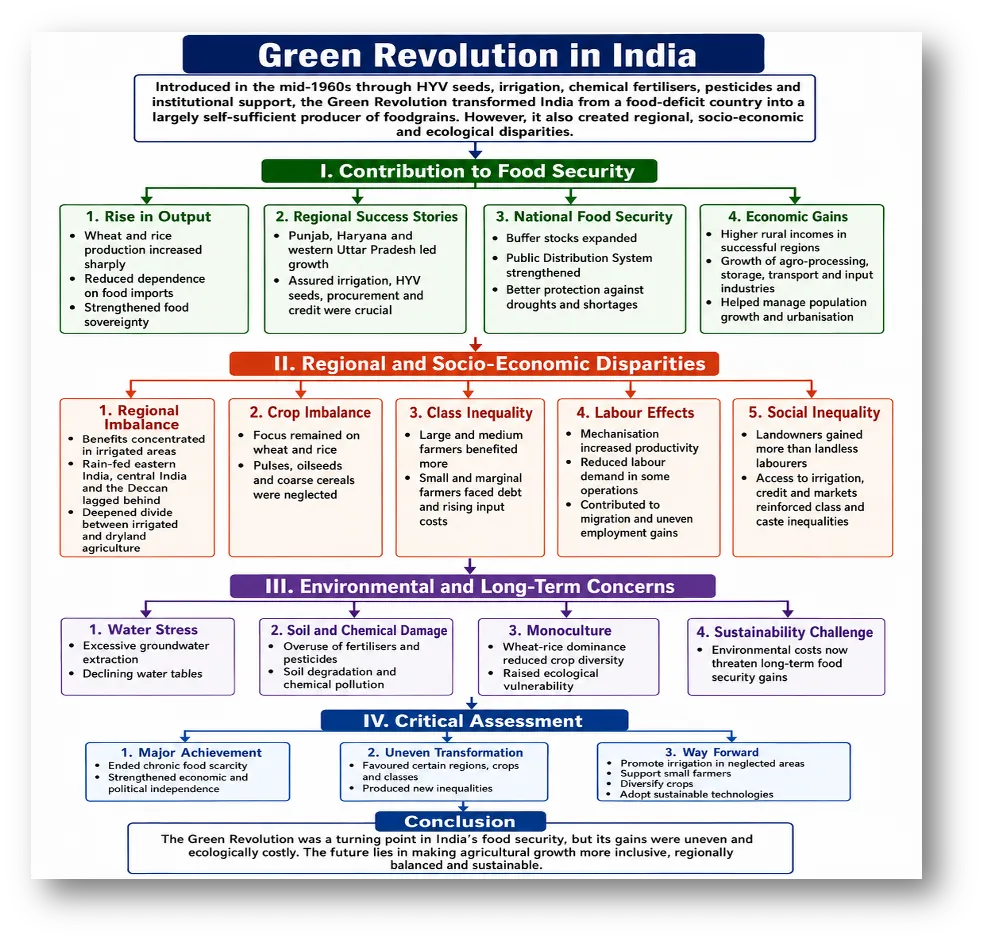
The Green Revolution, introduced in the mid-1960s through high-yielding varieties, irrigation, chemical fertilisers, pesticides and institutional support, transformed India from a food-deficit country into a largely self-sufficient producer of foodgrains. However, its benefits were unevenly distributed across regions, crops and social groups, creating new forms of inequality.
Contribution to food security
- The rapid increase in wheat and rice production reduced India’s dependence on food imports and strengthened national food sovereignty.
- States such as Punjab, Haryana and western Uttar Pradesh recorded substantial gains because of assured irrigation, HYV seeds, procurement and access to agricultural credit.
- Higher production helped the government build buffer stocks and expand the Public Distribution System, thereby improving protection against droughts and food shortages.
- Agricultural commercialisation increased rural incomes in successful regions and supported the growth of agro-processing, transport, storage and input industries.
- The Green Revolution also improved the state’s ability to manage population growth and urbanisation without recurring fears of famine.
Regional disparities
- The technology was concentrated mainly in areas with reliable irrigation, electricity, roads and market access. Rain-fed regions of eastern India, central India and the Deccan received fewer benefits.
- Punjab and Haryana became major food-surplus regions, while states with weaker infrastructure remained dependent on low-productivity agriculture.
- The focus on wheat and rice marginalised coarse cereals, pulses and oilseeds, which were more suitable for dryland regions.
- As a result, the Green Revolution deepened the divide between irrigated and rain-fed agriculture.
Socio-economic disparities
- Large and medium farmers benefited more because they could afford tractors, tube wells, fertilisers, pesticides and improved seeds.
- Small and marginal farmers often faced debt, rising input costs and dependence on informal credit.
- Mechanisation increased productivity but reduced the demand for certain forms of agricultural labour, contributing to rural unemployment and migration in some areas.
- Landowners gained from higher output and procurement prices, while landless labourers did not receive an equal share of the benefits.
- Unequal access to irrigation, credit and markets reinforced existing inequalities based on class, caste and landownership.
Environmental and long-term concerns
- Excessive use of groundwater, fertilisers and pesticides caused soil degradation, water depletion and chemical pollution.
- The wheat-rice monoculture reduced crop diversity and increased ecological vulnerability.
- These environmental costs now threaten the long-term sustainability of the food-security gains achieved by the Green Revolution.
- The Green Revolution was a major achievement because it ended chronic food scarcity and strengthened India’s economic and political independence. Yet, it produced an uneven agricultural transformation that favoured certain regions, crops and classes. The next phase of agricultural policy must therefore promote irrigation in neglected areas, support small farmers, diversify crops and adopt sustainable technologies so that food security becomes both inclusive and ecologically durable.
MAINS A DAY
General Studies I


General Studies I
UPSC Mains PYQs